
Does This Keep You Up at Night?
- Repeated damage to material handling equipment
- Constant forklift vibration and driver discomfort
- Slowed operations across joint crossings
- Rising maintenance costs
- Safety and product-handling concerns
SmoothJoint™ Solves These Issues
The current solutions I see on the market consist of filling these joints with rigid or elastic materials. They work temporarily, but the same problems come back, simply because the root causes are never addressed. This is how we're different.
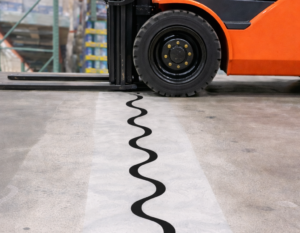
A curved S-shaped joint
Instead of a straight line, we anchor a joint shaped like an S. Because of the curve, forklift wheels are never hitting the joint at a 90-degree angle.
Result: the edge is protected and wear is drastically reduced.
A joint composed of two anchored parts
Each side of the joint is anchored into the slab.
That means that when the slab continues to open (concrete shrinkage is a long process), both parts of the joint move apart with the concrete, still protecting the edge.
Result: no more progressive edge degradation.
A composite, non-metallic joint
The joint is made of a composite material — it doesn’t rust, it doesn’t corrode, and it absorbs impacts far better than metal systems.
Fixing elevation differences
If there are height differences between slabs, we fill the cavities with a resin mortar stronger than concrete itself.
Both the mortar and the joint can be ground to perfectly match the slab edges. Result: an absolutely smooth transition — hence the name Smooth Joint.